Material requirements planning (MRP) is a planning method that calculates which components and raw materials a manufacturer needs, how many, and when to order or make them, so that a production schedule can be met. It works backward from what you plan to build: it explodes each finished product through its bill of materials, subtracts the stock you already have or have on order, and offsets the remaining need by the lead time to produce a dated list of planned orders.
The primary objective of MRP is to have the right material available for production at the right time while holding as little inventory as possible. Everything else it does, from realistic delivery dates to exception messages, follows from that calculation.
MRP at a glance
- Three inputs: the master production schedule (what and when), the bill of materials (what each product is made of), and inventory records (what is on hand, on order, and how long it takes to get more).
- Four calculations: gross requirements, netting against stock, lot sizing, and lead time offsetting, repeated level by level down the bill of materials.
- One main output: planned orders to buy or make each component, plus messages to expedite, delay, or cancel existing orders.
- It plans dependent demand. Components are planned from the products they go into, not forecast on their own. Finished goods demand still comes from orders or a demand forecast.
- Its accuracy is its inputs’ accuracy. A wrong bill of materials, stock balance, or lead time produces a confident, wrong plan.
The three inputs of material requirements planning
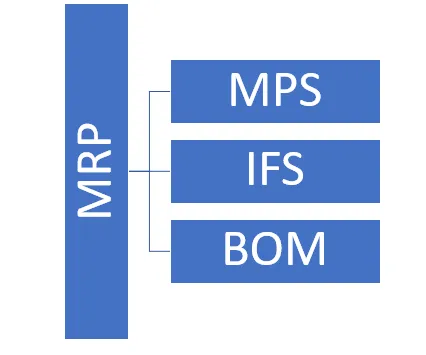
1. Master production schedule (MPS)
The MPS states which finished products will be completed, in what quantity, and in which period. It is built from customer orders and forecasts and then checked against capacity. Because MRP explodes the MPS into every component need, an unrealistic MPS creates an unrealistic material plan.
2. Bill of materials (BOM)
The BOM lists every component, subassembly, and raw material in a product, the quantity per unit, and the structure (which parts go into which subassemblies). MRP reads it level by level: the finished product is level 0, its direct components are level 1, and so on.
3. Inventory records
For every item MRP needs the on-hand quantity, scheduled receipts (open purchase and production orders), allocated quantities, lead time, lot sizing rule, and any safety stock. These records are why MRP depends on disciplined receiving, issuing, and cycle counting.
How the MRP process works, step by step
Microsoft’s documentation for Dynamics 365 describes master planning as determining “the future need for raw materials and capacity” and notes that “the master plan calculates net requirements” (Microsoft Learn, checked September 2026). Under the software, the logic is the classic MRP sequence:
- Gross requirements. Take the demand for an item in each period: from the MPS for finished goods, or from the planned orders of parent items for components.
- Netting. Subtract projected on-hand stock and scheduled receipts, and add back any safety stock target. What remains is the net requirement.
- Lot sizing. Round the net requirement to an order quantity: lot-for-lot, a fixed order quantity, a minimum, or a multiple of a pack size.
- Lead time offset. Move the order back by the item’s lead time, so the release date is early enough for the material to arrive when it is needed.
- Explosion. Multiply each planned order by the BOM quantities to create gross requirements for the next level down, then repeat steps 1 to 4 for every component.
Worked example: planning desk legs
Here is a small example. A workshop builds desks. Each desk uses 4 legs.
Level 0, the desk. The master production schedule calls for 100 desks in week 5 and 150 desks in week 7. There are 20 finished desks in stock, and assembly takes 1 week.
- Week 5 net requirement: 100 minus the 20 in stock = 80 desks, released for assembly in week 4.
- Week 7 net requirement: 150 desks, released for assembly in week 6.
Level 1, the legs. Each desk order releases a requirement for 4 legs in the week assembly starts, so the gross requirement is 320 legs in week 4 (80 x 4) and 600 legs in week 6 (150 x 4). There are 150 legs on hand, a purchase order for 200 legs arrives in week 3, the supplier lead time is 2 weeks, and the lot size rule is lot-for-lot.
| Week | Gross need | Receipts | On hand at end | Net need | Order release |
|---|---|---|---|---|---|
| 3 | 0 | 200 | 350 | 0 | 0 |
| 4 | 320 | 0 | 30 | 0 | 570 |
| 5 | 0 | 0 | 30 | 0 | 0 |
| 6 | 600 | 570 | 0 | 570 | 0 |
The 30 legs left after week 4 cover part of the week 6 need, so the net requirement in week 6 is 570. With a 2 week lead time, MRP tells the buyer to release a purchase order for 570 legs in week 4. If the supplier sells legs only in boxes of 100, the lot sizing rule would raise that order to 600 and leave 30 legs in stock after week 6.
That is the whole method. A real plan repeats this for thousands of items and several BOM levels, which is why MRP became a software function early on.
Objectives of material requirements planning
The objectives of MRP follow directly from the calculation:
- Ensure material availability. Components and raw materials are available when production needs them, and finished products are available for customer delivery.
- Keep inventory as low as practical. Ordering only the net requirement, timed by lead time, avoids buying months of stock “just in case” and frees working capital.
- Plan purchasing and production activities. Planned orders tell buyers and schedulers what to release and when, instead of reacting to shortages.
- Support realistic delivery dates. Because material availability is planned, sales can promise dates the plant can actually meet.
- Flag exceptions early. Reschedule messages show when an open order should be pulled in, pushed out, or cancelled because demand changed.
- Improve coordination. Purchasing, production, inventory control, and sales work from the same plan, which reduces expediting and the flow problems that come with it.
MRP, MRP II, ERP, and DDMRP
| Term | What it adds | Scope |
|---|---|---|
| MRP | Material quantities and timing from the MPS and BOM | Materials |
| MRP II (manufacturing resource planning) | Capacity planning, shop floor control, and financial links | Materials, capacity, cost |
| ERP | Finance, sales, purchasing, HR, and more on one database, with MRP as a module | Whole business |
| DDMRP | Strategic decoupling buffers sized from actual demand | Materials, buffer positioning |
The terms describe layers rather than rivals. Most modern ERP systems run an MRP or master planning engine inside. Demand-driven MRP is a newer method that changes where and how stock is buffered; our honest look at DDMRP covers what it gets right and what it oversells.
MRP vs kanban
MRP and kanban answer the same question in opposite ways. MRP pushes: it plans orders ahead of need from a schedule. A kanban inventory system pulls: it refills only what was consumed. Plants commonly use both, with MRP for long lead time, engineered, or expensive components and kanban for high-volume, low-cost parts with steady usage.
Why MRP plans go wrong
- Inaccurate inventory records. If the system thinks 150 legs are on hand and the shelf holds 90, the plan is short by 60 before it starts. Regular cycle counts and inventory control are prerequisites, not extras.
- Wrong or outdated bills of materials. A missing component or a wrong quantity per unit multiplies through every order.
- Optimistic lead times. Lead times set once and never measured are the most common cause of late material.
- An unrealistic master schedule. MRP assumes the MPS is achievable. If capacity cannot build it, the material plan is fiction.
- Plan nervousness. Frequent small MPS changes ripple into constant reschedule messages. Freezing the near-term schedule and using sensible lot sizes calms the plan.
Frequently asked questions
What is MRP in simple terms?
MRP is a calculation that answers three questions for every component: what do we need, how many, and when must we order it, based on what we plan to build and what we already have.
What are the three main inputs of MRP?
The master production schedule, the bill of materials, and the inventory status records, which include on-hand stock, open orders, lead times, and lot sizing rules.
What are the main objectives of MRP?
To make sure materials are available for production and products are available for customers, to keep inventory as low as practical, and to plan manufacturing, purchasing, and delivery activities.
Who uses MRP?
Manufacturers and assemblers of every size, from job shops to process plants, and any business that builds products from components with meaningful lead times. The discipline was formalized by the production and inventory control profession through APICS, which renamed itself the Association for Supply Chain Management in October 2018 (Logistics Management).
Is MRP the same as ERP?
No. MRP is the material planning function. ERP is the wider business system that usually contains an MRP or master planning module alongside finance, sales, and purchasing. For how an inventory tool supports the plant floor around MRP, see how inventory management tools help manufacturing companies. ZapInventory is one inventory application that supports bills of materials for production planning.